Sleep Science
The Temperature under Your Covers Matters More Than You May Think.
We all know how important a good night's sleep is. So we do our best to get it right.
We choose the right mattress.
Find the perfect pillow.
Set the room temperature.
And make time for a full night's sleep.
But there's one thing we rarely think about.
The temperature under our covers.
It's the space closest to our bodies all night long. And research shows that the temperature and humidity around us can affect how comfortably we sleep. Scientists call this environment the “bed microclimate.”
Could this be the missing piece of your sleep comfort?

01 / Bed Microclimate
Meet Your Bed's Microclimate
Most of us think a warm comforter for winter and a cool one for summer are all we need. Especially when we've invested in a high-quality comforter.
But what happens under your covers is more complex than you might think.
Your body keeps producing heat even while you sleep.
The heat your body produces and the heat it releases need to stay in balance for you to feel comfortable.
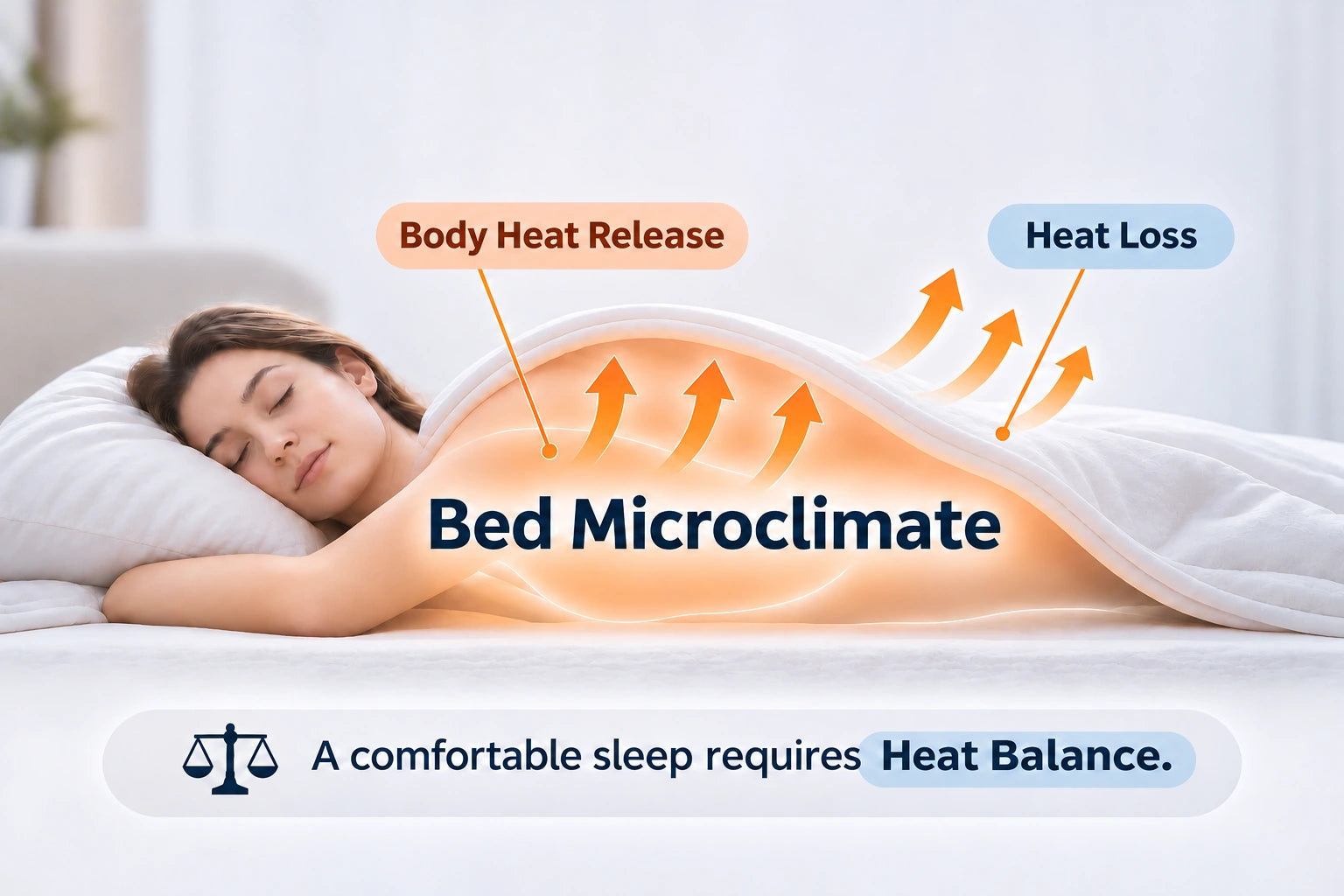
When too much heat builds up under your covers, you feel hot. When too much escapes, you feel cold.
In either case, your body responds on its own. You sweat to release heat when you're too hot, and curl up to keep more heat from escaping when you're too cold.
You may not be aware of every one of these natural responses. Yet they can still affect how well you sleep.
That means an unbalanced bed microclimate could be one reason you wake up feeling less rested than you expected.
02 / The Challenge
Can Your Comforter Keep Up With Changes in Your Bed Microclimate?
Research suggests that a comfortable temperature under the covers is around 90–93°F (32–34°C).1
Most comforters have a certain level of warmth and breathability, shaped by their materials, weight, and thickness.
But your body releases different amounts of heat throughout the night, while the temperature around you may change, too.
That's why it is difficult for most comforters to maintain a consistently comfortable temperature under your covers.
We've all experienced it. Waking up too hot and kicking off the covers. Or waking up cold and pulling them back on. Especially when the seasons change and your comforter no longer feels quite right.
But what if your comforter could do more?
03 / PCM Science
Climate Control — An Innovative Approach to Sleep Comfort
Imagine a comforter that could absorb heat when you're too warm—and release it when temperatures drop.
The idea isn't new.
Technology that absorbs and releases heat has even been used in clothing developed for space applications.
Think of snow melting. It absorbs heat as it melts. When that water freezes again, it releases heat into its surroundings.
That's called a phase change.
Different materials change phase at different temperatures, absorbing or releasing heat in the process.
Interactive illustration
Solid → liquid. The material absorbs heat as it changes phase.

The key is choosing a material that changes phase within a temperature range that helps keep you comfortable.
Now imagine that technology built into the fibers of your comforter.
As temperatures change, PCM in the comforter can absorb excess heat and release stored heat—helping create a more stable bed microclimate.
04 / Material Engineering
There's More to It Than PCM
Choosing the right PCM is only the beginning.
But how much heat does the PCM need to absorb and release throughout the night?
The heat-storage capacity (measured in joules) matters.
The difference between the heat your body produces and the heat that escapes from under your covers is what PCM helps balance.
And how much heat needs to be balanced depends on the comforter's design—its insulation (measured in CLO), thickness, loft, and breathability.
The real challenge is getting these elements to work together.
That's what makes designing a climate control comforter more complex than designing a traditional comforter.
05 / Award-Winning Innovation
From Award-Winning Innovation to Your Bedroom

Among the winners of the 2025 iF Design Award was a comforter built around this very idea.
It's the ESCURA Tw® Cool + Cozy Climate Control All-Season Comforter.
Plant-based PCM is built into its Lyocell fibers, while insulation and breathability are carefully balanced for sleep comfort.
“We know how frustrating it is to wake up too hot or too cold, night after night, when all you want is a good night's sleep. That's what drove us to study the science of the bed microclimate and find a way to bring it into a comforter. It wasn't easy, but if our work can help more people sleep comfortably through the night, every bit of effort was worth it.”
— Wayne, Brand Director, ESCURA
The innovative comforter raised over $540,000 through crowdfunding campaigns, including Kickstarter.
And now, you can find it on Amazon.
Explore on Amazon (opens in a new tab)References
- Okamoto-Mizuno, K., & Mizuno, K. (2012). Effects of thermal environment on sleep and circadian rhythm. Journal of Physiological Anthropology, 31, 14.
